|
To all the
techno-weenies with your space-age outdoor gear, Cody Lundin has some
advice: for that day when your butt's on the line, you better know
how to get primitive.
"This is
for you?" The sales clerk asked as I discreetly pushed the magazine
toward the cash register.
Having to crouch
in front of the "guns and ammo" section of the newsstand
was bad enough -- people pretended not to notice me leafing through
magazines like Soldier of Fortune. Now I was being put on the
spot about my suspicious behavior.
"I'm just
doing research about, about..." I stuttered sheepishly as she
put the camo-adorned magazine in a bag and, with furrowed brow, waited
for me to complete the sentence. "I just want to...I think I
want to go to survival school."
There, I said
it. I want to go to survival school. Despite years of experience in
the backcountry and hauling myself out of more than a few scary situations,
survival school has been on my mind of late. All this talk about Y2K
and computers going berserk has me thinking about my dependence on
technology and how vulnerable that makes me -- not in the city, where
ATMs crashing and grocery stores running out of toilet paper are the
big techno fears, but in the backcountry. Out there, Gore-Tex, factory-sealed
seams, and synthetic fills keep me warm, dry, and safe, but what if
something goes wrong? What if a bear drags away my pack? Or my tent
and everything in it blow into a crevasse? Or an avalanche or rockslide
buries my basecamp while I'm dayhiking? High-tech gear doesn't mean
squat when it's unusable -- or worse, suddenly not there -- and you're
15 miles from the trailhead.
"It's the
Y2K phenomenon on a backpacking level," according to Cody Lundin,
a primitive-skills guru who hikes barefoot and carries little more
than a wool blanket on extended wilderness treks. "Most backpackers
today travel in a gear bubble. And when your livelihood is totally
reliant on modern gear technology, the prospect of that technology
failing can be pretty scary."
Lundin's words
ring true for me. I'm always well outfitted on my wilderness trips,
and my comfort and well-being are directly related to that expensive,
high-tech gear. But what if...? Could I make it without the contents
of my backpack?
That's why I have
decided to go in search of a wilderness survival school, and how I
have come to share a campfire, started more with primitive skills
than with kindling, with Lundin. He runs the Prescott, Arizona-based
Aboriginal Living Skills School (ALSS), and plans to teach me the
survival basics -- skills all backcountry travelers once knew but
"have lost over the centuries" -- during an intensive weekend-long
field session.
I'm skeptical,
of course. Aside from the ultraright-wing, militia-sympathizing stigma
associated with many survival schools, there's the Y2K-tainted question
of whether such training is just plain bogus and rooted in fear mongering.
What could an experienced backpacker not already know?
"A lot,"
says Lundin. This modern-day aborigine (his e-mail moniker is "abo
dude") assures me there are Stone-Age techniques and "doing
more with less" wisdom that can be life saving, even liberating,
for today's backpackers. I found some consolidation in the fact that
his brochure clearly states, "ALSS adventures are not Rambo-style
courses." Good, because I'm not interested in being GI Jane or
a cave woman. I just want to be a better prepared backpacker.
Finding the right
survival-skills teacher is more involved than looking for the "Wilderness
Survival Schools" listing in the Yellow Pages. The term "wilderness
survival," after all, is highly ambiguous and associated with
an array of outdoor pursuits. Searching for "wilderness survival"
on the Internet yields Web sites dealing with everything from New-Age
meditation to storing five year's worth of food to military combat
manuals on CC-ROM. The search is further complicated by Y2K-related
fears that have fueled a survivalist cottage industry catering to
people -- many keenly interested in arming themselves -- preparing
to live off the grid. (For more tips on finding the right school,
see "Survival Schools" on page 150.)
After
wading through all the paramilitary hype, two large wilderness survival
schools stood out: Boulder Outdoor Survival School (BOSS) based in
Boulder, Colorado, and Tom Brown's Tracker School in Asbury, New Jersey.
Both schools harken back to ancient Native American lifestyles and
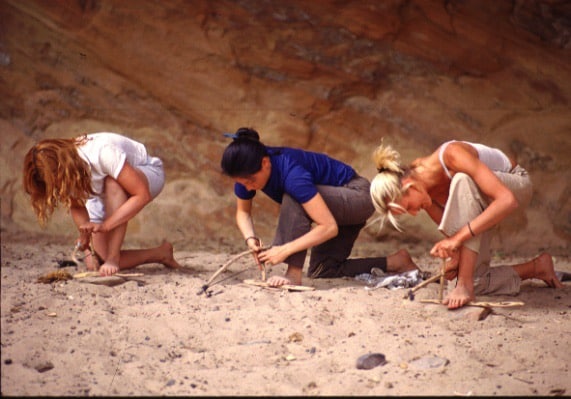
teach primitive skills, such as starting a fire with a bow drill,
foraging for food, and making stone tools.
BOSS
was the brainchild of Larry Dean Olsen, who decided to teach primitive-living
skills ("no kit nor any premanufactured items") in the '60s
after authoring the book, Outdoor Survival Skills. Similarly, Brown's
biography, The Tracker, which details his apprenticeship in the New
Jersey Pine Barrens under an Apache medicine man, gave rise to the
Tracker wilderness survival school in 1978. (For more on Brown, see
"Secrets To Survival," October 1992). Today, both schools
employ staffs of knowledgeable instructors, offer a variety of courses,
and have slick public relations/advertising agencies representing
them. According to BOSS President Josh Bernstein, enrollment at his
school has increased 400 percent in the past four years. Brown experienced
similar exponential growth, and both say Y2K paranoia had little to
do with it. In fact, Bernstein Says, the rush has been made up of
"well-traveled outdoorspeople."
Despite
the success and mass marketing of the two popular schools, neither
has ventured from its original focus of teaching primitive techniques
for wilderness survival. "Traditional living and survival skills
immerse you into nature, forcing you to adapt to the local resources
and environmental conditions," explains Bernstein. "There's
an awakening inside you that says, 'I've made fire like this before.
And, I am a part of the natural world.'" I know several BOSS
alumni who say they experienced life-altering revelations during the
school's arduous field courses. I'm not looking for spiritual awakening,
though. I just want to know what to do if my pack sails off the side
of a mountain.
Which
is what has brought me to Cody Lundin. Like many founders of small,
regional survival schools around the country, he's a protégé
of one of the big two. After completing a 14-day BOSS field course,
he joined the school's instructor staff. In 1991, he struck out on
his own and founded the Aboriginal Living Skills School. Among his
clients are Arizona's Prescott College, and international disaster-relief
agency, and the central Arizona Yavapai Apache tribe, who hired Lundin
to teach the tribe's youth about their disappearing heritage in primitive
skills.
What makes Lundin's
school different from BOSS and the Tracker School, which teach solely
primitive skills, is that he also teaches "modern survival skills."
"Primitive
skills help get you in tune with and live in the environment. Modern
survival has to do with getting out of a bad situation alive,"
he told me. "About 75 percent of what I teach is modern survival
because that's what people want. They have practical, valid concerns
and want to know how to get out of a pinch."
Lundin doesn't
abandon primitive skills. During my telephone research, I learned
that he teaches what could be called "street smarts" once
commonly practiced by prehistoric people -- things like finding water
by digging an "Indian well" and knowing the vegetation that
indicates water is near (see "Finding Water on page 49). On the
other hand, if it's cold and raining and you're near hypothermic,
Lundin says rigging a tarp out of a space blanket ("plastic is
awesome") is better than spending an hour building an anthropologically
correct lean-to out of forest debris.
Exactly the kind
of survival skills, and attitude, I was seeking.
I also liked Lundin's
proven history and clientele list, but the deciding factor to go with
his outfit was that he lives and teaches in the Arizona desert where
I do most of my hiking. Getting stranded in the desert is a different
ball game from, say, being lost in the dense forests of New England,
and I wanted someone who knows how to tackle my waterless, cactus-filled
turf.
Despite his credentials
and the fact that he's a successful entrepreneur, Lundin, 32, isn't
your typical CEO. When he jumps out of his Jeep to begin our hike,
his long blonde hair frames his face in two braids. A bandanna covers
the top of his head, he sports a nose ring and tattoos, and he's barefoot.
Heavy metal meets ancient Native American.
If Lundin were
standing at a city crosswalk and my mother was sitting in her car
at the stoplight, she would nervously lock her doors. But it takes
only a few minutes of hiking with Lundin to realize that the derelictlike
appearance of abo dude is a direct result of his all-consuming passion
for wilderness survival.
"This is
a lifestyle for me, not just a way to make a living," he says,
his thick-padded feet rolling over sharp volcanic rocks and shuffling
around prickly pear as we head toward central Arizona's Verde River.
He never wears shoes, not even in snow ("Don't want my feet to
get soft"), and I can't help but wince with his every step. "I'm
very passionate about doing more with less. That's what primitive
living is all about," Lundin adds.
During the cushy
"modern" excursions, though, he allows himself a few conveniences
-- Nalgene water bottles, matches, bagels, and thank goodness, clothes
-- that aren't kosher on a "primitive trip." While I lug
my backpack, he carries everything in a fanny pack.
Once we get to
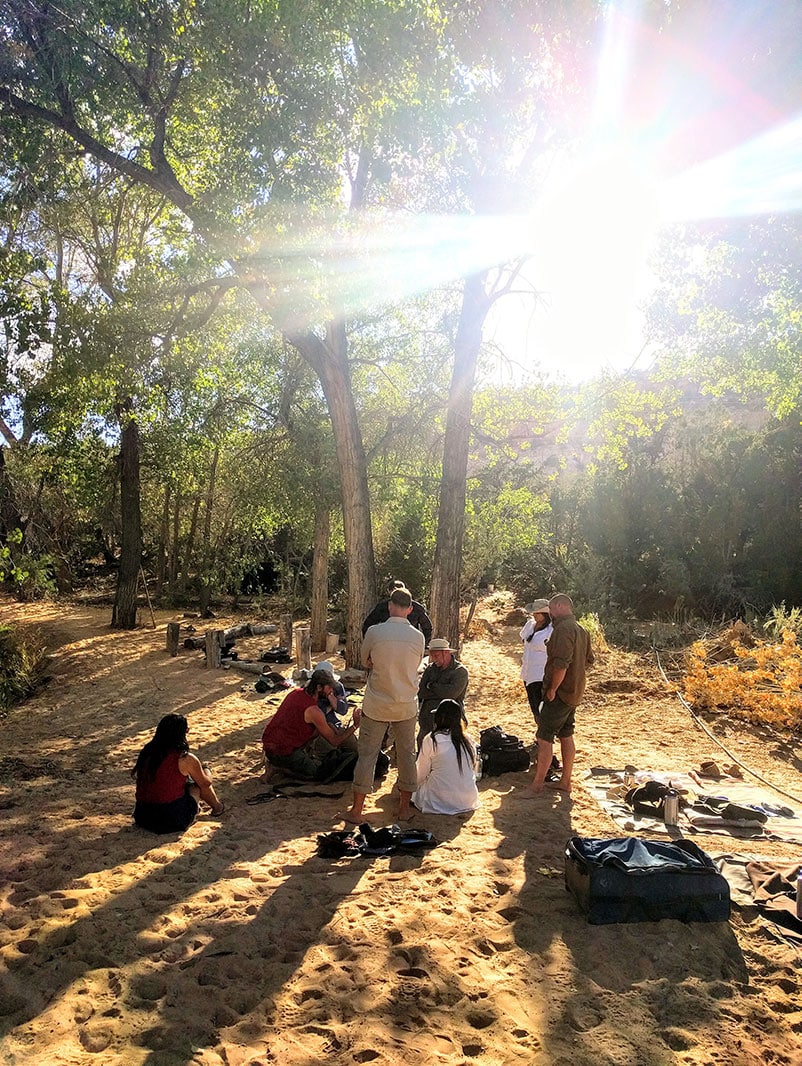
the river and set up camp (Lundin merely unfurls his wool blanket),
we sit down in the sand. Lundin pulls out a clipboard, draws a bull's-eye,
and says, "Everything we talk about over the next few days is
in the center of this bull's-eye. It's core knowledge about how to
keep your body alive." He taps with a marker near the perimeter
of the bull's-eye. "Out here is making moccasins and birch bark
canoes. Modern backpackers don't need to know that. But whether I'm
Donald Trump or a Tarahumaran bushman, if I'm stuck in a survival
situation and I don't know these skills in the center -- finding water,
starting a fire, finding shelter, making a survival kit, planning
ahead, signaling for help -- then I'm not going to be on planet Earth
much longer." He points again to the center. "This is a
very small amount of material to know about living in the wilderness."
Like eating bugs?
Digging up grubs for dinner and catching fish with your bare hands
are probably what most people think when wilderness survival is mentioned,
but Lundin says these things aren't core. According to the "rules
of threes," you can live 3 hours without warmth in cold conditions,
three days without water, but "at least three weeks without food.
It's not a priority in a short-term survival situation," he explains.
That's why you should be more concerned about hypothermia, "the
number one killer in the bush." Clothing is your basic form of
shelter, he notes. "Beyond that, you can improvise with items
you have in your survival kit, such as trash bags for rain protection
and a space blanket for a tarp. Keeping a small fire going is also
critical."
Central to Lundin's
approach to modern survival is his homemade survival kit. Weighing
just under 4 pounds and small enough to fit easily in a fanny pack,
the kit contains multiple-use items that will help any hiker stay
warm, hydrated, and able to signal for help (see "survival Kit.")
He recommends that fully equipped backpackers carry the fanny pack
kit separate and wear it at all times.
After the bull's-eye
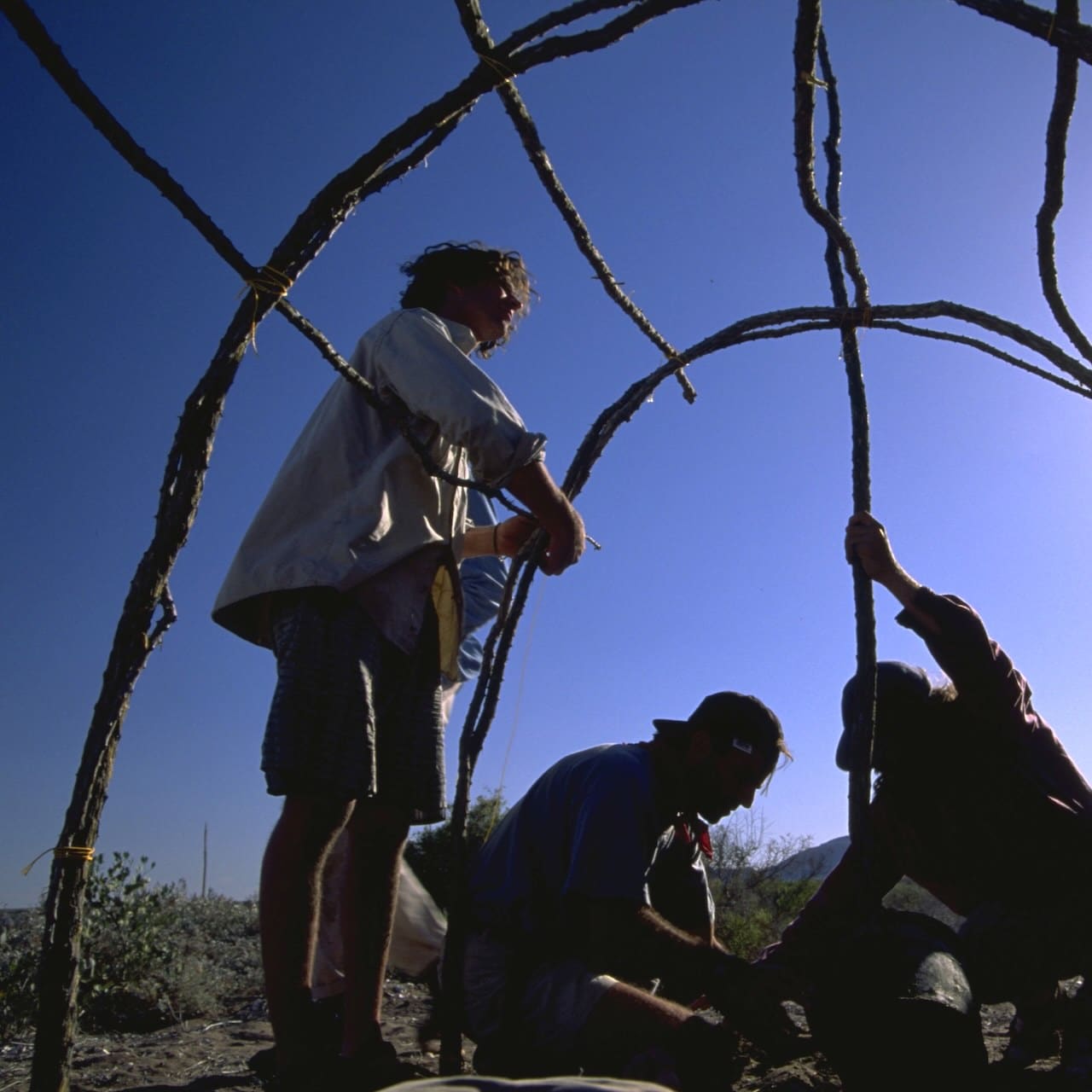
lecture, Lundin puts me to work, and the rest of the two days fly
by as I practice various skills. Call it a survival fire drill.
"Your body
needs to feel what it's like to build a still," says Lundin as
I try to rig a plastic bag over a clump of tree branches (see "Finding
Water" on page 49). "If you don't get hands-on experience
with these skills during a survival course, you might as well just
read a book on the subject and save your money."
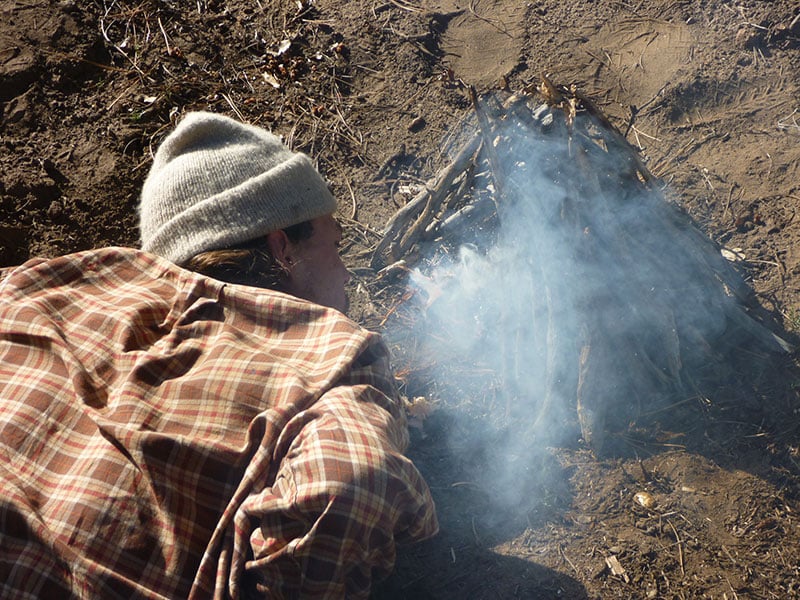
Under Lundin's
constant watch and advice, I spend nearly an hour gathering fuel for
a small tepee-sytle fire. I'm allowed only half a single paper match
(I peeled it apart at the center to make two), so my fire better ignite
easily, otherwise I'm going to freeze. "Some of your kindling
is too big. You're going to need smaller twigs," he instructs,
looking at my piles of wood.
After my fuel
supply gets Lundin's seal of approval, I build the tepee. Lundin has
me remodel it several times: once so the fuel wood is more closely
and evenly spaced, and then to make my fire configuration a little
more haphazard. "Fire likes chaos," he says.
Finally, it's
showtime. I nervously strike the split match and stick the feeble
flicker beneath my arched tinder platform. Poof! The tepee ignites
as if it were doused with gasoline. I am amazed. Of all the fires
I've built over the years, I've never started one without huffing
and puffing to keep it going. And it's always taken more than one
match. I thought I knew how to build a proper fire, but clearly, I
didn't (see "Starting A Fire" on page 48).
Next, Lundin,
a self-described "pyro," has me create fire starters. I
slather a cotton ball in petroleum jelly, then pull it apart and light
the dry center. This ingenious brand of "tech-no-tinder"
burns for 5 minutes. But equally impressive is the Stone-Age-era tinder
bundle: a palm-sized bird's nest of juniper bark, the center filled
with finely ground bark. The bundle burns twice as long as the cotton
ball, and as Lundin pints out, it's portable, "like a fireplace
you can hold in your hand."
Nothing is left
to chance. I even practice using the sighting hole on a signal mirror
(see "Signaling" on page 54). "You don't want to be
lost the first time you try to signal for help," says Lundin
as I squint and try to line up the sighting hole with a point up toward
a mountain-top. It takes me a few attempts, but I finally hit my distant
target with a glint of reflected light.
Although I already
know some of the things Lundin covers -- for example, layering clothing
and carrying plenty of water -- discussing them in the context of
survival reinforces their importance. Other random bits of survival
wisdom, such as how to craft a whistle out of scrap metal and use
a condom as an emergency canteen (I stood in the river and filled
one with at least a liter of water), I never would have learned without
taking Lundin's class.
After my days
with Lundin, I'm thankful when a backpacking trip goes smoothly and
I don't have to use the skills he taught me. And I may never have
to, but knowing I possess the knowledge puts me more at ease in remote
wilderness areas, especially when my 2-year-old son comes along.
Considering the
hundreds of dollars I spend each year on "just in case"
insurance policies, the quality wilderness survival training I got
from Lundin was a bargain. Practicing the skills in the field engraved
them in my memory. I'll still pack a stove, but if something goes
wrong with it, I know I can start a fire quickly to warm myself. I've
learned where to look for water in seemingly dry locations. I have
the life-sustaining essentials in the survival kit around my waist.
The desert will not do me in, even if my technologically advanced
gear fails.
You could say
I'm Y2K ready, at least on a backpacking level.
Sidebar 1:
STARTING A FIRE
Building a campfire
for the heck of it isn't environmentally sound, but in an emergency
a small fire can save your life. Hypothermia, remember? Build a tepee
from the outside in. Use fuel sticks no bigger around than your thumb,
spaced symmetrically 1/2 inch apart. Add larger wood in below-freezing
conditions. Place kindling -- twigs, from pencil-lead thin to the
thickness of a drinking straw -- between the fuel sticks and haphazardly
inside the tepee. Scatter fine, extremely dry tinder inside the tepee.
Tinder can be bark from birch, juniper, or cedar; inner bark of any
tree; dry moss; pine needles; cattail down; a termite nest; sunflower
pith; even dry grass. If it is raining, put the tinder material in
your shirt to help it dry quickly. Create an arch underneath the tinder
where you can place the flame to start the fire. "Know the exact
spot where you're going to place the match," says Cody Lundin.
Sidebar 2:
FINDING WATER
Staying well hydrated
is essential to maintaining physical and mental function, so drink
at least a gallon of water per day, and even more in hot environs.
Carry iodine to purify water, but if you're in a survival mode and
can't treat the water, drink it anyway. Better to chance getting sick
than risk not living to worry about it. If your supply runs out, climb
to a hilltop and look for signs of water, especially in the early
morning when the water table is at its highest, reflections of pools
are easier to spot, and birds and insects often swarm wet areas. Don't
overlook dew; early morning moisture on leaves can be soaked up with
a bandanna and wrung into a container. Vegetation that indicates water
includes cottonwood trees (roots can go 40 to 60 feet down, so you
might not be able to dig far enough), willows, cattails, velvet ash,
sycamore, mesquite, and bermudagrass.
A solar tree sill
is easy to make. Tie a plastic bag around a group of heavily vegetated
tree or bush branches that are exposed to direct sunlight. Rig the
bag so that all moisture from the leaves will run down into a weighted
lower corner. This yields about 2 to 3 tablespoons in average desert
conditions. If you're lucky, you may fare better with an Indian well
dug in a sandy wash that drains the area during rain. The hole should
be 1 to 2 feet deep and preferably on the outer bend of the wash.
It could take up to an hour for water to seep into the hole if it's
down there. This method also can be used in coastal regions where
no fresh water is in the vicinity. Dig the hole on the inland side
of sand dunes. Several wells will improve your odds, and if all you
get is mud, wring it out in a bandanna to extract the moisture. When
in cold environs, be sure to melt snow before consuming it, because
ingesting too much cold stuff can lead to hypothermia.
Sidebar 3:
BUILDING A SHELTER
Your primary shelter
is clothing, so play it safe on excursions from camp and take a jacket
and hat. On every trip, pack a synthetic or wool next-to-skin layer,
an insulating middle layer, and a waterproof exterior shell jacket.
If you need to rig a secondary shelter in the form of a lean-to, use
man-made materials whenever possible. "It is much easier and
quicker to build a lean-to with a space blanket or a tube tent with
a trash bags hung over a rope than with debris," says Lundin.
The reflective side of a space blanket will divert the sun's rays
in the desert and retain body heat in cold conditions. If you must
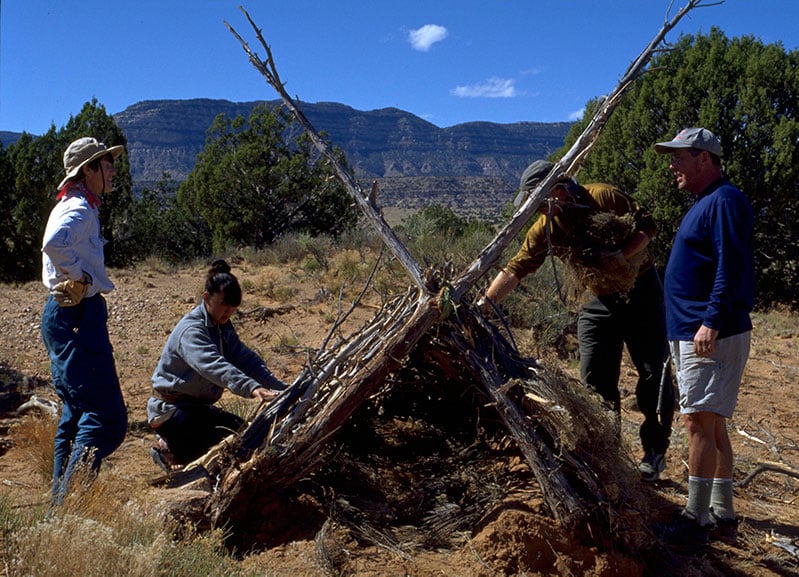
use natural materials to build a shelter, make the walls thick and
angled to shed water and provide insulation. The simplest shelter
is a lean-to constructed against a tree trunk or rock. Soak up the
head radiating from a tree canopy, big rock, or another person. You
can also make a lean-to suitable for sleeping by layering debris over
a fallen log. See "Pockets of Weather" (Wild Things, August)
for tips on where to place your shelter to warm up or cool off.
Sidebar 4:
SIGNALING
If you left your
itinerary with a responsible adult, someone will be looking for you
when you don't return. Help them find you by using the three basic
types of signals: mirror, ground to air, and sound. A commercial signal
mirror with a sighting hole is one of the best ways to attract the
attention of overflying aircraft because it can be seen 50 miles away.
Plastic mirrors don't work nearly as well. A CD-ROM disc makes a great
makeshift signal mirror, plus it has a sighting hole, shine the reflected
light in the pilot's face. (Use a tree or bluff, not a real plane
when practicing.) You can also attract the attention of aircraft by
laying your space blanket on the ground, reflective side up. Or make
a big X on the ground (universal sign of distress) with gear or by
digging an embankment in snow. A hot coal bed piled with green vegetation
will make white smoke that's easier for rescuers to see. Three fires
in a triangle can be seen from 30 miles away. Also, don't forget about
sound signals. Sound out SOS by blowing three short, three long, then
three short whistles. If rescuers are near, bang on pots and pans.
Sidebar 5:
SURVIVAL KIT
Make Your Own
Backcountry Insurance Policy
For just a few
bucks, you can build a "Lundin special" that'll get you
out of all kinds of trouble. Fold everything neatly, pack efficiently,
and the whole 3 pound 14 ounce kit and caboodle will fit inside a
standard fanny pack. The survival kit is intended to supplement the
regular contents of a hiker's pack. It should be worn at all times
and separate from the backpack. Don't leave camp without it. Here's
what you will need:
- One each of
gallon -- and quart-size zipper-lock bags for holding water and
building stills; the bags should have wide mouths so you can skim
for water and reach into crevices.
- Tincture of
iodine to disinfect water; use five drops per quart. 2 condoms to
use as canteens.
- Plastic drinking
tube (3 feet long) for drinking from stills or crevices.
- Orange flagging
tape to mark your route or write a message.
- Dental floss
(100 feet); a tough string for many uses.
- Duct tape (3
feet); get the strongest variety available.
- Mini flashlight
with spare bulb.
- Extra flashlight
batteries with date marked; replace every 12 months.
- Magnesium block
with striking insert; carry a minimum of three means of starting
a fire.
- Cigarette lighter;
get a bright color so you won't lose it.
- Strike-anywhere
matches dipped in paraffin
- Firestarters;
cotton balls saturated with petroleum jelly and stuffed in a film
container pack the smallest, but you can also use chips or other
dry, fatty foods or even dryer lint coated with paraffin.
- Magnifying
glass for signaling and fire starting. Glass signal mirror with
sighting hole and a whistle.
- Light space
blanket for shelter and signaling.
- Heavy duty
space blanket with grommets and reflective side for shelter and
signaling.
- Three heavy-duty,
plastic leaf bags; use as a rainsuit, shelter, tube tent, tarp,
or for collecting rainwater.
- Military parachute
cord (50 feet), 550-pound test.
- Extra knife;
should be all -- purpose with a fixed, double-edged, carbon steel
blade that can throw a spark.
- Brightly colored
bandanna; doubles as a pot holder, hat, and water filter.
- Basic first-aid
kit; contains wound dressing, moleskin, antibiotic ointment, and
other items.
- Topo map and
compass.
RESOURCES
Outdoor Survival
Skills, 6th edition, by Larry Dean Olsen (1997; Chicago Review
Press, Chicago, IL; 800-888-4741; $14.95).
Primitive Living
and Survival Skills, by John and Geri McPherson (1994; Prairie
Wolf Publishing, Randolph, KS; $9.95).
The Tracker,
by Tom Brown, Jr. with William Jon Watkins (1986; Berkley Publishing
Group, New York, NY; 800-631-8571; $6.99).
Tom Brown's
Field Guide to Wilderness Survival, by Tom Brown, Jr. with Brandt
Morgan (1987; Berkley Publishing Group, New York, NY; 800-631-8571;
$12.95).
Wilderness
Survival, by Gregory J. Davenport (1998; Stackpole Books, Mechanicsburg,
PA; 800-732-3669; $14.95).
SURVIVAL SCHOOLS
With no agencies
regulating the survival industry, just about anybody can hang a shingle
that says "Wilderness Survival Training." That means you
need to do your homework to find a reliable school that's worth your
time and money.
Start your search
the old-fashioned way: Talk to friends and acquaintances who have
first-hand experience, and look for brochures at your local outfitters.
Then check the Wilderness Schools Home Page on the Internet at www.geosmith.com/wilderness.
Survival
schools aimed at outdoor recreationists are listed based on recommendations
from Web site viewers and the brochure and promotional materials of
the school.
Once you've found
a few schools you're interested in, study their Web sites and request
brochures and course schedules. Most schools aimed at outdoor recreationists
clearly say so in the mission statement.
Call the school
and ask about the balance between teaching primitive living and modern
survival skills to see if the school's education priorities match
yours. Also ask for a list of satisfied customers, and make sure the
course is at least 70 percent hands-on training.
Ask how the school
deals with environmental impact during field courses. Building fires,
foraging, and constructing debris shelters can damage sensitive environments.
Responsible schools have a method for mitigating impact on the outdoors.
|